Table of contents
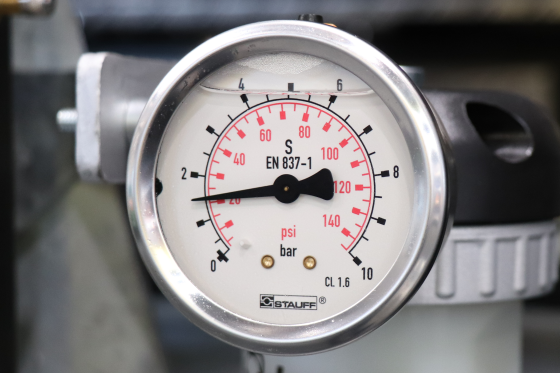
Mechanical pressure measurement technology as a functional supplement to digital systems
Mechanical, non-electrical pressure measurement technology is not a discontinued model in data centres, but a deliberately used tool with a clearly defined purpose. It is used wherever temporary measurements are required, for example during commissioning, acceptance tests, service work or targeted troubleshooting. In these situations, the focus is on reliability, immediate operational readiness and minimising disruption to ongoing operations.
Digital sensor technology fulfils other tasks. It is ideal for continuous condition monitoring, for long-term recording and for integration into higher-level monitoring and evaluation systems. Mechanical measurement technology does not replace these systems, but complements them where simplicity, robustness and independence from power supply, software or interfaces are crucial.
Pressure measurements as a safety-relevant component of cooling circuits
Coolant circuits are a central component of the operational safety of data centres. They ensure that servers, network technology and power supplies operate within defined temperature ranges. Pressure measurements provide important information about the condition of the system.
Typical applications include
Pressure and leak tests during commissioning and acceptance
Checking defined operating states during operation
Localisation of faults, leaks or blockages
For these tasks in particular, it is often necessary to carry out measurements during operation without opening the cooling circuit or taking systems out of operation. Mechanical pressure measurement technology enables precisely this type of safe, temporary testing.
Clear division of tasks between analogue and digital pressure measurement technology
In modern data centres, there is no competition between analogue and digital pressure measurement technology, but rather a clear functional division of tasks. Digital sensor technology is designed for continuous operation. It continuously supplies measured values, enables trend analyses and supports the documentation and optimisation of overall operation.
Mechanical measurement technology, on the other hand, is predestined for selective measurements. It is used specifically when concrete questions need to be answered, for example as part of an acceptance test or when troubleshooting. This separation ensures clear processes, reduces complexity and increases operational reliability.
The mechanical pressure measuring point as an infrastructural basis
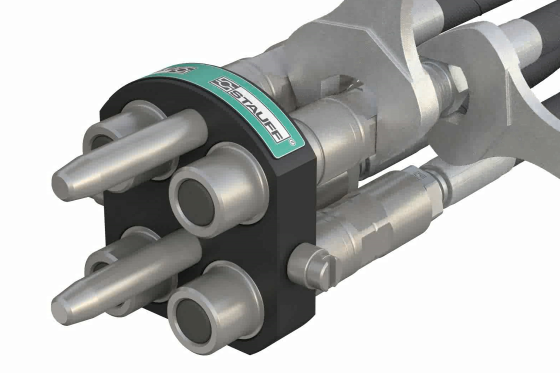
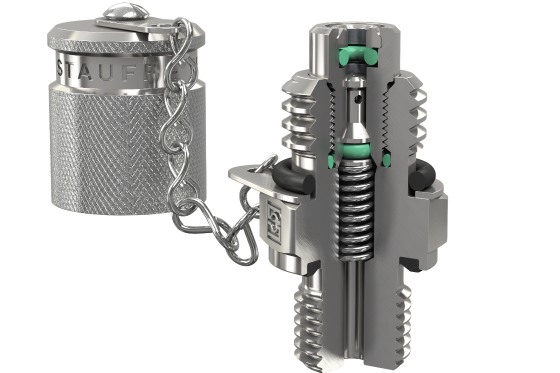
Regardless of which type of measurement technology is used, the measuring coupling, i.e. the mechanical pressure measuring point, forms the central interface in the system. It is permanently installed and enables the flexible connection of analogue measuring devices as well as digital sensors.
The use of standardised measuring couplings offers several advantages:
Measurements can be carried out during operation
Systems remain modular and scalable
Retrofitting and conversions are possible without temporary solutions
For reasons of flexibility, digital sensors are also often not permanently integrated, but connected via mechanical pressure measuring points. The mechanical measuring point is therefore the infrastructural basis for both measurement technologies.
Technical requirements for pressure measuring points in data centres
Pressure measuring points in data centres must function reliably over the long term and meet high safety requirements. They are usually permanently installed and form the interface for temporary measurements during operation. The requirements for design, material selection and handling are correspondingly high.
The key requirements include
- coupling and uncoupling of measuring devices without additional tools and without system downtime
- Minimised media leakage from the system and the lowest possible air intake
- Permanent freedom from leakage, even at low but constant static pressures
- High mechanical reliability over long periods of time
- Maintenance-free and simple, safe handling
- Media compatibility with typical coolants, especially water-glycol mixtures
In addition, standardisation and interoperability are crucial to ensure high availability, interchangeability and security of supply over the entire life cycle of the system. Standardised interfaces facilitate procurement, spare parts management and the use of different measuring devices or sensors.
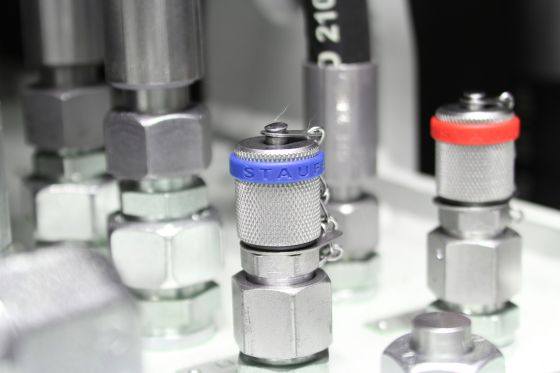
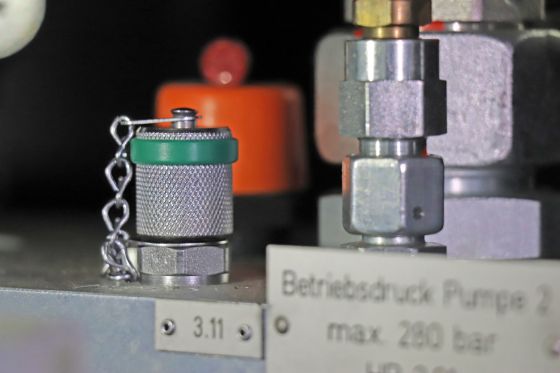
In addition to the functional design, visual labelling of the pressure measuring points can also offer practical added value. The option of equipping protective caps on measuring couplings with coloured marking rings allows individual lines or areas to be quickly visually identified, for example to differentiate between supply and return or between cold and hot circuits. Colour markings are already established for other components such as quick-release couplings or valves and can also contribute to clarity and avoid confusion at pressure measuring points.
Safety reserves instead of supposed oversizing
Measuring couplings used in hydraulic and fluid technology are often designed for very high operating pressures. In cooling circuits of data centres, which usually work with comparatively low pressures, this design appears oversized at first glance.
In practice, however, it offers precisely the safety reserves that are expected in sensitive infrastructures. A robust mechanical design ensures reliable tightness, high load-bearing capacity and long-term stability - even with permanent low pressure, load changes or vibrations. This reserve is not a disadvantage, but a deliberate factor in minimising risk.
Measuring hoses as safety-relevant connecting elements
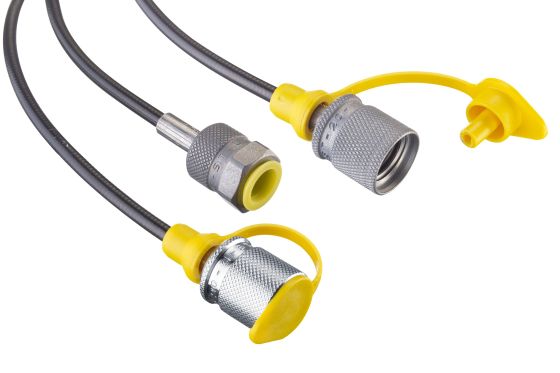
Measuring hoses play a central role in temporary pressure measurements. They connect the pressure measuring point with the measuring device or sensor system and must fulfil high requirements.
Essential criteria are
Small internal volume to reduce media loss and air entrainment
Defined, screwed connections for reliable connections
Low stored energy to minimise risks in the event of hose failure
High flexibility combined with good mechanical resistance
Suitable measuring hoses contribute significantly to the safety of personnel and systems, especially when servicing.
Analogue pressure gauges for precise measurements in the low pressure range
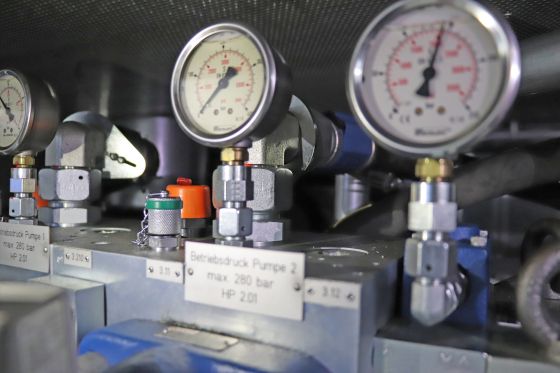
Coolant circuits in data centres typically operate in low pressure ranges. Analogue pressure gauges must therefore be specially designed for these requirements. High resolution, good readability and a robust design are crucial in order to deliver reliable and reproducible results, even for temporary measurements.
Compact pressure gauges with a clearly designed scale are particularly suitable for mobile use during service and maintenance work. Dual scales with bar and psi facilitate international use and support collaboration with global teams. In addition, STAUFF scale plates can be customised, for example with customer-specific units other than bar or psi and with customer logos. This enables clear assignment and supports standardised service processes.
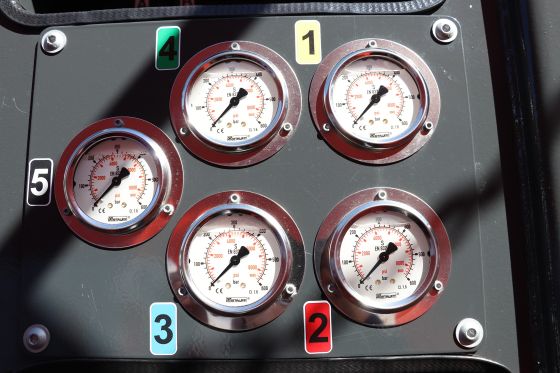
Practical measuring cases from STAUFF
Pre-configured service cases have also proven their worth for practical use in the field. They combine pressure gauges, adaptors and measuring hoses in a compact, transportable solution and can be customised for specific applications. Such service cases make work on site easier, ensure clear processes and ensure that the right components are always available for different measuring tasks.
Typical application situations for mechanical pressure measurement technology in operation
Mechanical pressure measurement technology is used wherever reliable measured values are needed at short notice and maximum flexibility is required. Typical application situations are
Commissioning and acceptance of new cooling circuits
Temporary inspections as part of conversions or extensions
Service and maintenance operations
Targeted troubleshooting in the event of deviations during operation
In these cases, mechanical measurement technology enables quick decisions to be made without additional system complexity or intervention in the existing infrastructure.
FAQs
Why is mechanical pressure measurement technology still relevant in data centres?
Mechanical pressure measurement technology enables safe, temporary measurements during operation, without electrical approvals, power supply or software. It is particularly indispensable for commissioning, maintenance and service.
Can digital pressure sensors replace mechanical measuring points?
No. Digital pressure sensors are also often connected via mechanical pressure measuring points to enable modularity, interchangeability and flexible retrofitting.
What are the advantages of non-electrical pressure measuring devices in the data centre?
Non-electrical pressure measuring devices do not cause any electromagnetic interference, do not require a power supply and are immediately ready for use. This is a clear advantage in sensitive IT infrastructures.
Why are robust measuring couplings from the hydraulics sector used?
The robust design ensures high tightness, mechanical safety and long-term reliability - even at low operating pressures and continuous use.
In which situations is analogue pressure measurement technology particularly useful?
Analogue pressure measurement technology is particularly useful during commissioning, acceptance, servicing and targeted troubleshooting when fast, flexible and independent measurements are required.

Newsletter subscription
Subscribe now and don't miss any new articles!