目录
- What is the difference between pipe anchor, pipe guides and sliding support?
- How does a pipe anchor or fixed support work?
- How does a pipe guide or guiding support work?
- What is the difference between a sliding support and a guiding support?
- Why are fixed supports and guiding supports important in pipework?
- How can pipe guides be implemented using STAUFF pipe clamps?
- FAQs
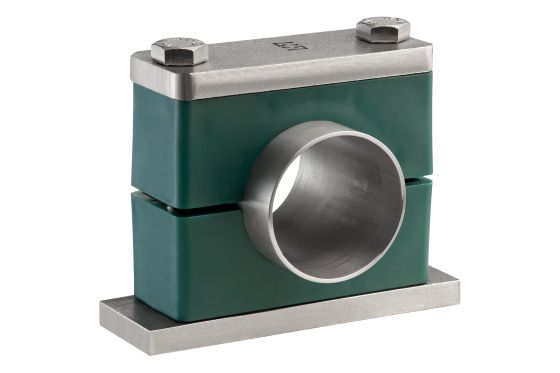
What is the difference between pipe anchor, pipe guides and sliding support?
A pipe anchor secures the pipework and, in particular, prevents movement in the axial direction. A pipe guide guides the pipework but allows axial movement within the mounting. With a sliding support, on the other hand, the pipework and the mounting can move together relative to the substrate.
pipe anchor, pipe guide and sliding support therefore differ primarily in terms of which components are permitted to move and which directions of movement are allowed.
This distinction is important for the fixing of pipework. After all, a pipe should not, as a general rule, be clamped as tightly as possible at every point. Depending on the design and operating conditions, deliberately defined movement options may be necessary.
In the STAUFF context, two terms are of particular focus here: pipe anchor and pipe guides. They are also referred to as fixed support and guiding support.
Put simply, the difference can be summarised as follows:
Pipe anchor or fixed support: Pipe fixed, fixing fixed
Pipe guide or guiding support: Pipe axially movable, mounting fixed
Sliding support: Pipe and mounting move together relative to the supporting surface
How does a pipe anchor or fixed support work?
A pipe anchor, also known as fixed support, secures a pipe at a defined position. Movement of the pipe is prevented at this point, particularly in the axial direction.
The fixed point must therefore also be able to absorb the forces generated by the pipe’s fixation. The fixing here does not merely serve to hold or guide the pipe; it establishes a fixed reference point within the pipework system.
The term ‘fixed support’ can easily lead to misunderstanding: the entire pipework does not necessarily have to be rigidly fixed simply because it has a fixed point. Depending on the design, additional support may be provided alongside a pipe anchor to allow specific movements of the pipework. This is precisely where the pipe guide comes into play.
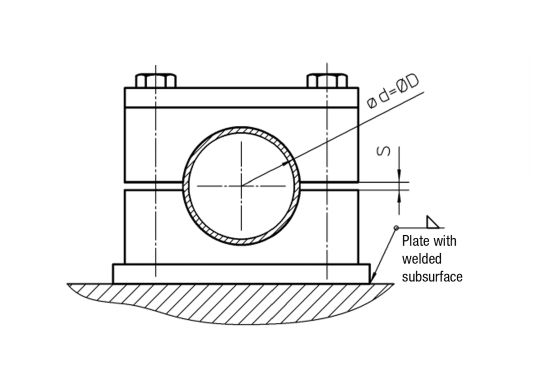
ØD – diameter of the clamp (pipe support); Ød – pipe diameter; S – gap
How does a pipe guide or guiding support work?
A pipe guide, also known as a guiding support, supports and guides the pipework without restricting axial movement.
This does not mean that the pipe is unsecured. The pipe remains guided and is held in place in directions of movement not intended. In the axial direction, however, it can move within the guide.
To put it simply: whilst a pipe anchor determines the position of the pipe, a pipe guide specifies a defined path along which the pipe can move.
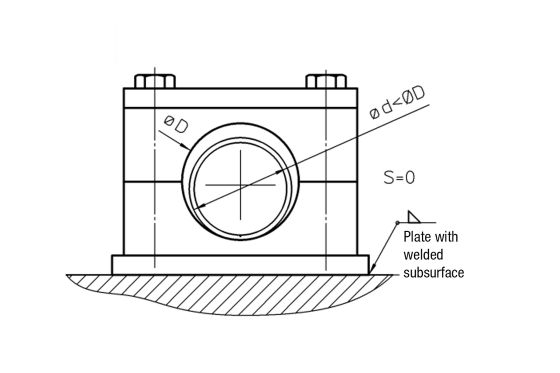
With a suitably designed pipe guide, the pipework can therefore slide in the longitudinal direction through the pipe clamp, whilst the pipe clamp itself remains firmly connected to the substructure.
It is crucial for the function of the sliding support that the pipe is guided and not clamped in place. The necessary dimensions depend on the specific design and the requirements of the application.
What is the difference between a sliding support and a guiding support?
Both pipe guide and sliding support allow for movement. Nevertheless, they do not refer to the same design principle.
With a pipe guide, the pipework moves within the fixed pipe clamp. With a sliding support, on the other hand, the pipe clamp moves together with the pipework it is holding relative to the supporting structure.
The key difference therefore lies in the point at which the relative movement takes place.
With a guiding support, the pipe clamp remains firmly mounted to the substructure. However, there is sufficient play between the pipework and the pipe clamp to allow the pipework to move axially.
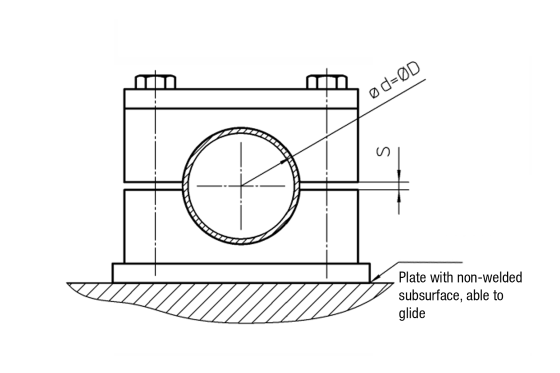
With a sliding support, the pipe clamp holds the pipe in place. However, the pipe clamp – or rather its base plate – is designed in such a way that it can move relative to the supporting structure. The pipe and clamp move together in this case.
The distinction can therefore be boiled down to a simple question:
What is actually sliding?
With a pipe guide, the pipe slides through the fixed guide. With a sliding support, the clamp slides together with the pipe on or relative to the supporting structure.
For applications using STAUFF pipe clamps, the principles of pipe anchors and pipe guides are particularly relevant.
Why are fixed supports and guiding supports important in pipework?
Pipework is exposed to various influences during operation. These include, amongst other things, temperature changes. If the temperature of a pipe changes, its length may also change.
Such thermal linear expansion must be taken into account when designing and securing pipework systems. If an anticipated change in length is prevented, additional forces may arise within the system.
Pipe anchors and pipe guides therefore fulfil different but coordinated functions.
A pipe anchor defines a fixed position within the system and prevents axial movement of the pipe at that point. A guiding support guides the pipe whilst allowing a defined amount of movement along the pipe’s axis.
The principle is therefore not to fix a pipe either ‘rigidly’ or ‘loosely’. Rather, it is a matter of selectively preventing or allowing movement.
The number, position and design of pipe anchors and pipe guides required depend on the specific design and operating conditions of the pipework system.
How can pipe guides be implemented using STAUFF pipe clamps?
Depending on the design, STAUFF pipe clamps can perform various functions in the fixing and guidance of pipework. Whilst a fixed pipe fixing prevents movement of the pipe, the design as a pipe guide requires a specifically tailored selection and dimensioning of the Clamp Bodies.
One example of this is the STAUFF H-type clamp with a smooth inside surface and no pre-tension. When used as a guiding support, the inner diameter of the Clamp Body is selected to be slightly larger than the Outside Diameter of the pipework to be secured.
As a result, the two clamp halves do not clamp the pipe tightly. Instead, the pipe is guided within the clamp and can move in the axial direction.
The basic relationship can be easily illustrated as follows:
Outside Diameter of the pipe < inner diameter of the Clamp Body
The clamp remains firmly attached to the supporting structure. The required degree of freedom is created between the pipework and the Clamp Body.
This makes the difference to a fixed support particularly clear: if the position of a pipe is to be strictly defined, the corresponding fixing must prevent axial displacement. If, on the other hand, the pipe is to be guided whilst at the same time being able to undergo a specified axial movement, a suitable design can be used as a pipe guide.
Which design and dimensions are suitable always depends on the specific application and the loads encountered there.
Thus, a seemingly simple task such as securing a pipe becomes a design question: where must the pipe be held in place, and where must it be able to move?
It is precisely this distinction between fixing and guiding that is crucial to understanding pipe anchor, pipe guides and sliding support.
FAQs
What is the difference between a pipe anchor and a sliding support?
A pipe anchor or fixed support prevents axial movement of the pipework and thus establishes a fixed position. A guiding support or pipe guide supports and guides the pipework, whilst allowing it to move within a defined range in the axial direction.
What is a ficed support in a pipework system?
A fixed support is a location at which the pipework is secured. In particular, it prevents axial movement and must be capable of absorbing the forces generated by this fixation.
What is a guiding supportin a pipework system?
A guiding support is another term for a pipe guide. The pipework is guided but not clamped in such a way as to prevent all movement. Axial displacement of the pipework remains possible.
Can a pipe move in a guiding support?
Yes. That is precisely the function of a pipe guide. The pipework can move axially within the guide, whilst movement in other directions is restricted.
What is the difference between a pipe guide and a sliding support?
In a pipe guide, the pipework moves within a fixed guide or pipe clamp. In a sliding support, the pipework is held by the clamp, whilst the clamp assembly can move together with the pipework relative to the supporting structure.
Why do pipework systems need pipe anchors and pipe guides?
Pipes can change in length due to factors such as temperature changes. Pipe anchors define fixed positions within the system, whilst pipe guides allow for specified axial movements whilst simultaneously guiding the pipe.
How can a STAUFF pipe clamp be used as a sliding support?
In a suitable design, the pipe is guided by the clamp halves but not clamped. In the H-type design shown, the internal diameter of the Clamp Body is selected to be slightly larger than the Outside Diameter of the pipe. This allows the pipe to move axially within the permanently mounted clamp.

Newsletter subscription
Sign up now and never miss another post!