Table of contents
Press release on this topic in *Konstruktionspraxis*
In the August issue of *Konstruktionspraxis*, you can read an interesting article on the STAUFF SFIS series of filters.
Why do contaminants enter the Hydraulic System despite the filtration design?
Even modern hydraulic systems equipped with pressure, return and Offline and Bypass Filters are not completely protected against contaminants. Contaminants can enter the system particularly when connecting or disconnecting hoses, when changing hydraulic attachments, and during maintenance and repair work. This is precisely where in-line safety filters come into play: they trap locally introduced contaminants before they reach sensitive components and impair the functioning of the hydraulic system.
The purity of the hydraulic oil is one of the most important factors for the operational reliability of hydraulic systems. Contaminated or aged oil is one of the most common causes of breakdowns. A well-designed filtration system therefore ensures that oil quality is maintained within the closed circuit. Nevertheless, potential entry points for contaminants remain. These include, in particular, couplings, hose connections and other areas that are regularly opened.
Even modern Flat Face Couplings can only minimise the risk of contamination, but cannot completely rule it out. In dusty or dirty environments, particles can adhere to coupling surfaces or hose ends and enter the Hydraulic System during the coupling process. This risk increases further as the number of equipment changes rises.
What is the role of in-line safety filters?
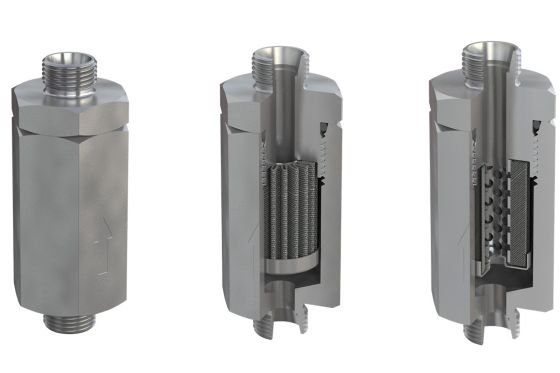
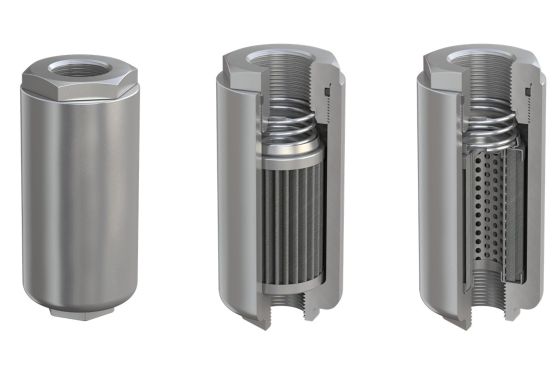
In-line safety filters add an extra level of protection to existing filtration systems. Unlike conventional hydraulic filters, they are not designed for the continuous fine filtration of the entire oil flow. Instead, they specifically protect individual components from locally introduced particles.
Among the particularly sensitive components in hydraulic systems are control, regulating and Throttle and Shut-Off Valves, valve blocks, proportional functions and hydraulic motors. Even a single contaminant particle can lead to increased wear, malfunctions or failures in these components. In-line safety filters prevent these particles from reaching the critical components in the first place.
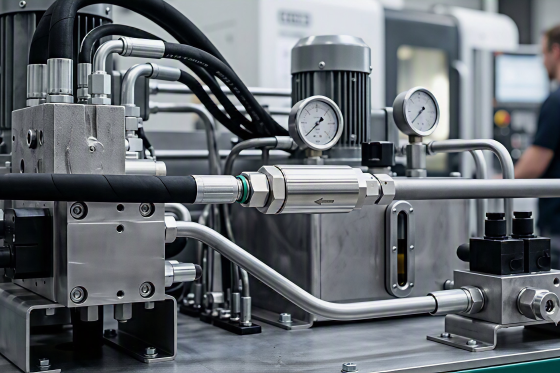
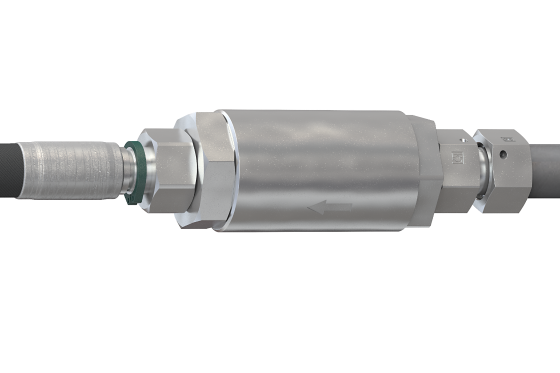
The filters are designed as compact line elements and are integrated directly into the hydraulic line. Typical installation locations are between couplings, hoses, connectors and valve blocks. This makes them suitable for both new designs and the retrofitting of existing hydraulic systems.
Why are coupling points particularly critical?
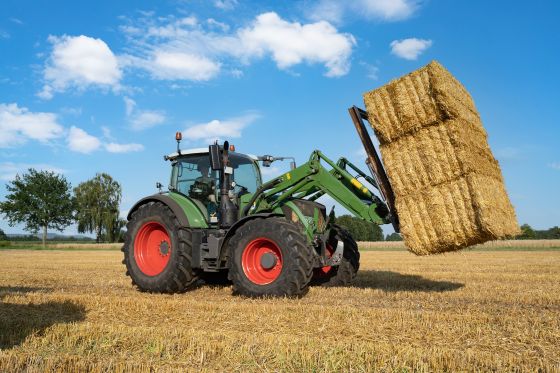
A typical example is agricultural machinery. Tractors and other agricultural machines frequently operate with a variety of attachments. Couplings and hose ends are regularly exposed to soil, dust and the elements. If particles enter the hydraulic circuit, they can be distributed throughout the entire system, where they may damage sensitive components.
By fitting an inline safety filter directly behind the coupling, dirt particles can be intercepted immediately at their point of entry. This prevents contaminants from reaching downstream components and causing damage there.
What advantages do in-line safety filters offer to OEMs and operators?
For machine manufacturers and operators, the availability of their systems is paramount. Unplanned downtime not only incurs costs but also impairs productivity and operational readiness. In-line safety filters play a key role in reducing the risk of contamination-related faults.
A further advantage lies in their flexible integration. The filters can be incorporated at the design stage or integrated into existing piping layouts at a later stage. This enables OEMs to implement this additional protection without making fundamental changes to the Hydraulic System.
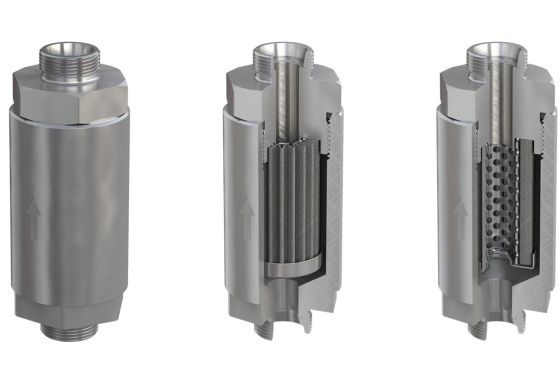
The SFIS series has been developed as a robust high-pressure component. The housing is made of carbon steel with a Zinc/Nickel coating for enhanced corrosion protection. The filters are designed for operating pressures of up to 250 bar and feature filter elements made from pleated Stainless Steel wire mesh. The enlarged filter surface area ensures a high contaminant holding capacity whilst maintaining a low differential pressure.
For manufacturers of premium machinery, this offers the opportunity to further enhance the reliability of hydraulic systems and to protect sensitive components in the long term.
STAUFF SFIS filters in our online shop
Take a look at our online shop now and find out all the details about STAUFF SFIS filters
For which applications is this design suitable?
In-line safety filters are suitable wherever hydraulic lines are regularly disconnected and reconnected, or where particularly sensitive components need to be protected. Their use is particularly relevant in mobile machinery operating under varying and, in some cases, heavily contaminated conditions.
Typical areas of application include agricultural machinery, Construction Machinery and municipal vehicles fitted with hydraulic attachments. Here, regular changes of equipment create a particularly high number of potential entry points for contaminants.
Furthermore, inline safety filters can also be fitted in return lines. In this position, they prevent particles from hydraulic attachments from entering the carrier vehicle’s hydraulic circuit. This creates an additional protective barrier between the machine and the attachment.
FAQs
How do contaminants enter a Hydraulic System?
Why are conventional hydraulic filters not always sufficient?
Conventional hydraulic filters provide continuous filtration of the oil circuit. However, they cannot prevent locally introduced particles from initially reaching sensitive components. Inline safety filters therefore supplement existing filtration systems by providing an additional level of protection.
Which components are particularly sensitive to contamination?
Where are in-line safety filters installed?
Can in-line safety filters be retrofitted?
For which machines are in-line safety filters particularly suitable?
How do inline safety filters contribute to machine availability?
How do in-line safety filters differ from pressure or Return-Line filters?

Newsletter sign-up
Sign up now and never miss another post!